

You can taste the difference between a good dab and a scorched one. The first fills your palate with citrus, pine, fuel, or sweet fruit. The second tastes like hot metal and regret.
That gap isn't just about personal preference. It comes down to chemistry. Every aromatic compound in a cannabis concentrate responds to heat in its own way, and once you understand those responses, you can control your experience with real precision. You'll also see why extraction methods built around fresh, native terpenes deserve gentler treatment once the jar is open.
What are terpenes, and why do they matter?
Terpenes are volatile aromatic compounds produced by plants. In cannabis, they form in the same glandular trichomes that produce THC and other cannabinoids. They're the reason one cultivar smells like a lemon grove and another smells like a pine forest after the rain.
Scientists have identified more than 150 terpenes in cannabis. A handful of them show up in large amounts and shape most of the aromas you'll recognize. Chemically, they fall into two main groups:
Monoterpenes are smaller, lighter molecules built from 10 carbon atoms. Myrcene, limonene, pinene, and linalool all belong here. They're highly volatile, which means they evaporate easily and carry the bright top notes of a cultivar.
Sesquiterpenes are larger molecules built from 15 carbon atoms. Beta-caryophyllene and humulene are common examples. They're heavier, less volatile, and usually add deeper, spicier, or woodier notes.
Terpenes matter for more than flavor. Many enthusiasts believe they shape the overall feel of an experience by working alongside cannabinoids, a theory known as the entourage effect. The research is still developing, but one thing is clear: terpenes define a cultivar's personality. Lose them, and you lose much of what makes each strain unique.
Why boiling points are the key to flavor
Every compound has a boiling point, the temperature where it shifts from liquid to vapor at normal atmospheric pressure. For terpenes, this number tells you a lot about how they'll behave on a hot surface.
Here's the core idea. When you heat a concentrate, you're not releasing everything at once. You're releasing compounds in waves. The lightest monoterpenes go first, then heavier terpenes and cannabinoids follow as temperatures climb. Push the heat too far, and those early compounds don't just vaporize. They can oxidize, degrade, or break apart entirely.
One important nuance: boiling point is a guide, not a hard switch. Terpenes are so volatile that they start evaporating well below their listed boiling points. That's why an open jar loses its smell over time and why storage matters as much as it does. On a dab surface, though, boiling points give you a useful map of where flavor lives.
Boiling points of key cannabis terpenes
The table below lists common cannabis terpenes and their approximate boiling points at standard atmospheric pressure. Values can vary slightly by source and measurement method.
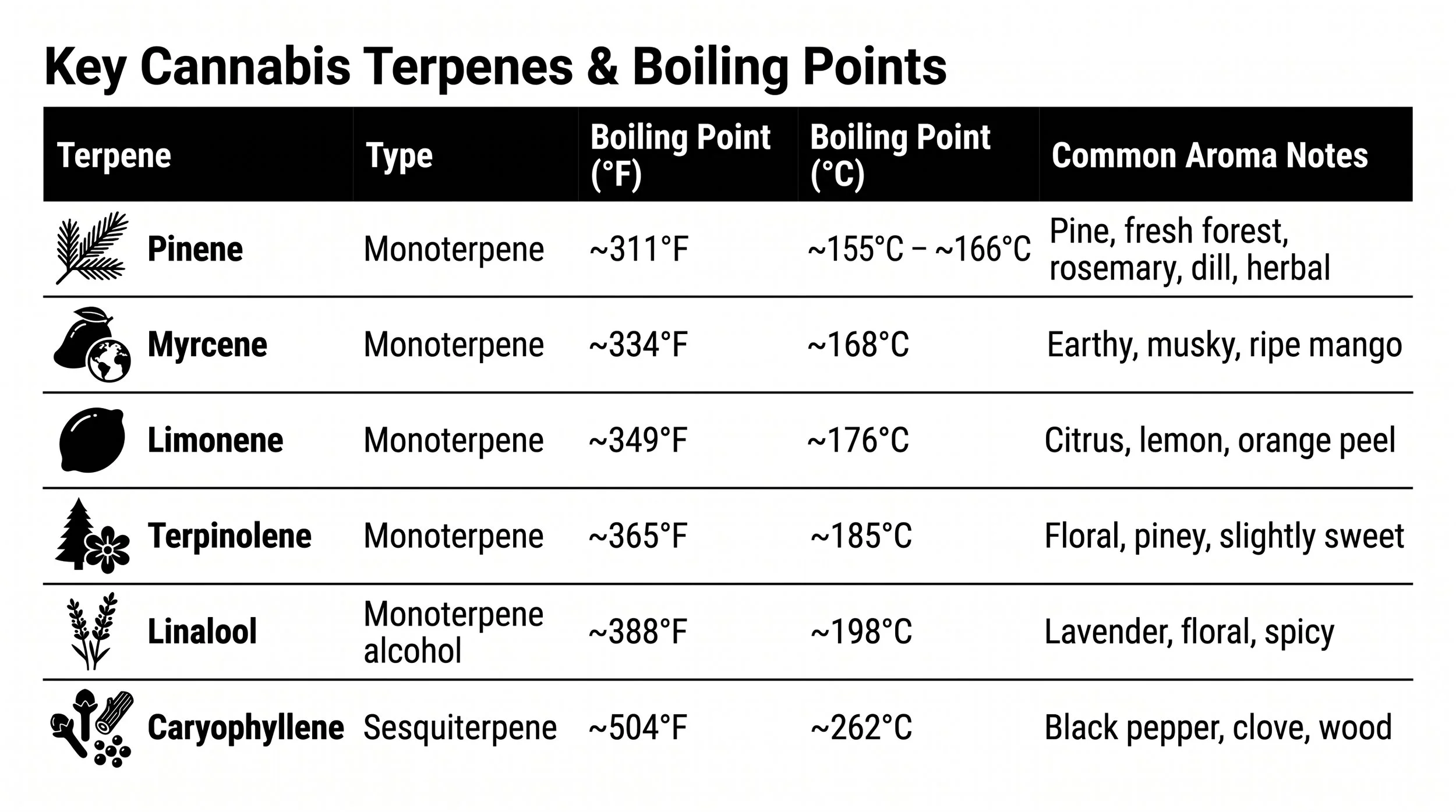
A quick note on beta-caryophyllene. You'll often see much lower numbers for it on cannabis temperature charts online. Its true boiling point at atmospheric pressure is far higher, around 504°F (262°C), which fits its larger sesquiterpene structure. In practice, it still contributes flavor at lower dab temps because it evaporates gradually, but it's one of the more heat-tolerant terpenes in the mix.
Look at the pattern. Nearly every major monoterpene boils between roughly 310°F and 390°F (155°C to 200°C). That's almost exactly the low-temp dabbing window. THC is commonly cited as vaporizing efficiently starting around 315°F (157°C), with other cannabinoids following at slightly higher temperatures. The overlap is the whole point: in the low-temp range, you're releasing both flavor and cannabinoids at once.
Low-temp vs. high-temp dabbing: what actually happens
Dab temperatures generally fall into three ranges. Each one produces a noticeably different experience.
Low-temp dabbing: 315°F to 400°F (157°C to 204°C)
This is the flavor zone. At these temperatures, monoterpenes like pinene, myrcene, limonene, and linalool vaporize cleanly instead of burning. Cannabinoids also release, but the vapor stays cool and smooth.
What you'll notice:
Sharper, clearer flavor that tastes like the cultivar
Smoother hits with less throat irritation
Less residue and scorching on your banger or nail
A more gradual, layered experience as compounds release in sequence
The trade-off is cloud size. Low-temp dabs produce thinner, wispier vapor. Some people read that as a weaker hit, but thin vapor is often packed with flavor. Big clouds are not the same thing as quality.
Medium-temp dabbing: 400°F to 600°F (204°C to 315°C)
This range balances flavor and vapor production. You'll get denser clouds and faster effects, while still keeping a good share of the terpene profile. The lightest monoterpenes may start to fade toward the top of this range, but many people find it a comfortable middle ground.
High-temp dabbing: above 600°F (315°C)
At this point, you're well past the boiling points of every major terpene. The goal here is usually massive vapor and immediate intensity, but it comes at a cost.
Light monoterpenes flash off almost instantly, often before you can taste them
Hits turn harsh, hot, and sometimes coughy
Concentrate can scorch on contact, leaving dark residue behind
Terpenes may break down into new compounds you didn't sign up for
That last point deserves attention. Research published in 2017 found that heating terpenes at high dabbing temperatures can produce degradation byproducts, including compounds like benzene and methacrolein, both known irritants. The levels rose as temperatures climbed. The takeaway isn't panic. It's that heat is a powerful chemical tool, and more of it doesn't mean a better experience.
Combustion vs. vaporization: the science behind the difference
These two words get used loosely, but they describe very different chemical processes.
Vaporization is a physical change. Heat gives molecules enough energy to escape from liquid into gas. The molecule itself stays intact. A limonene molecule that vaporizes is still limonene when it reaches your palate, which is why you taste citrus.
Combustion is a chemical reaction. It happens when material gets hot enough to react with oxygen and burn. Molecules break apart and recombine into new substances: carbon dioxide, water, carbon monoxide, tar, ash, and a long list of other byproducts. The original compounds are destroyed in the process.
When you light a joint, the burning tip runs far hotter than any vaporization temperature, often reaching well over 1,000°F. Terpenes near the ember get burned before they ever have a chance to vaporize. That's why smoke tastes like, well, smoke, even when the flower smells incredible in the jar.
Dabbing sits between these two worlds. Concentrates don't contain plant material, so a well-executed dab is mostly vaporization. But when a surface runs extremely hot, the line blurs. Oil can scorch, terpenes can break down, and you edge toward thermal degradation, a process called pyrolysis, where heat alone tears molecules apart. Low temperatures keep you firmly on the vaporization side of that line.
How ceramic coils maintain even, consistent heat
Everything that applies to a banger also applies inside a vape cartridge or all-in-one device. The heating element just works on a smaller scale.
Traditional vape coils use a metal wire wrapped around or through a wick, often made of cotton or silica. When you draw, current runs through the wire and heats it fast. The problem is that thin wire heats unevenly. Spots closest to the wire get very hot, while areas farther away stay cooler. Those hot spots can scorch oil, burn the wick, and create the dreaded "dry hit," where everything suddenly tastes burnt.
Ceramic heating elements take a different approach. Here's why they're kinder to terpenes:
Even heat distribution. Ceramic spreads heat across its whole surface rather than concentrating it along a thin wire. Oil vaporizes more uniformly, without small zones running dramatically hotter than the rest.
Thermal stability. Ceramic heats and cools more gradually than bare metal wire. That steadiness helps prevent sudden temperature spikes that flash off light monoterpenes.
Porous wicking. Many ceramic elements are porous, so they double as the wick. Oil soaks into the ceramic and feeds the heating surface steadily, which lowers the risk of a dry, scorched hit.
No cotton to burn. Without a cotton wick in direct contact with hot wire, there's no burnt-cotton flavor creeping into the vapor.
The result is a draw that tastes closer to the original concentrate, hit after hit. Hardware quality still matters, though. Ceramic elements vary widely depending on how they're made and how much power the battery sends to them. Higher voltage settings push temperatures up, which defeats much of the purpose. If your device lets you adjust power, the lowest setting that produces satisfying vapor is usually the most flavorful one. It's also worth choosing devices from reputable manufacturers that test their hardware.
Practical tips for preserving terpenes at home
You don't need a lab to put this chemistry to work. A few habits make a big difference.
Use a temperature-controlled device when possible. Electronic nails and smart rigs let you dial in an exact temperature and hold it steady, which takes the guesswork out entirely.
Try a cold start. Place your concentrate in a room-temperature banger, cap it, then apply heat gently. The oil warms up gradually and releases terpenes in sequence instead of all at once.
Use a carb cap. Covering the banger traps heat and lowers air pressure around the concentrate, helping it vaporize at lower surface temperatures.
Wait after torching. If you use a torch, let the banger cool before you dab. Timing varies by material and thickness, so an infrared thermometer is a smart, inexpensive tool.
Take smaller dabs. Smaller amounts vaporize more completely at low temperatures, with less pooled oil left behind.
Run your vape on low. If your battery has adjustable voltage, start at the lowest setting and work up only as needed.
Store concentrates cool and dark. Heat, light, and air pull terpenes out of a jar long before you dab them. Use airtight glass or silicone containers, and never leave concentrates in a hot car.
The bottom line: temperature is a flavor decision
Every terpene in your concentrate has a temperature where it shines and a point past which it starts to fade or break down. Most of the compounds responsible for cannabis's signature aromas vaporize between roughly 310°F and 390°F, which is exactly why low-temp dabbing delivers such vivid flavor. Ceramic coils bring the same principle to vape hardware by keeping heat even, steady, and controlled.
When you understand the chemistry, temperature stops being a random setting and becomes a deliberate choice. Go low, go slow, and let native terpenes show you what the cultivar was meant to taste like.
Legal Disclaimer
UCG Inc. and Dabstract offer this website for general informational purposes only. This information should not be used for diagnosis, nor should it be considered a replacement for consultation with a health care professional. If you have questions or concerns about your health, please contact your health care provider.
While UCG Inc. and Dabstract have endeavored to make sure the information contained in this web site is accurate, UCG Inc. and Dabstract cannot guarantee the accuracy of such information, and it is provided without warranty or guarantee of any kind.
Health information is provided for educational purposes and should not be used as a source of personal medical advice.